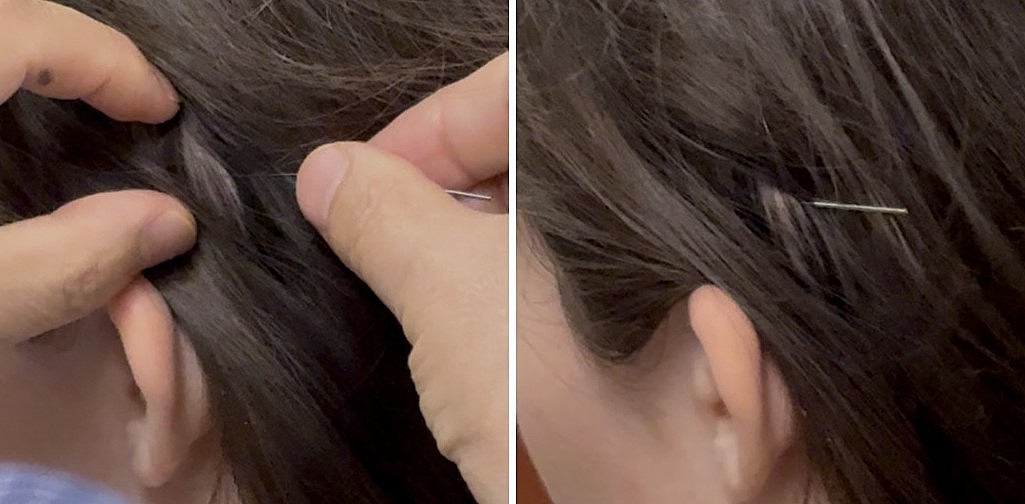
While acupuncture has successfully treated pain for thousands of years, the study of modern neurophysiology is increasingly able to explain the science behind why. Acupuncture needles have an effect on not only the local anatomy, but also on the spinal cord and the brain/central nervous system.
Local – Neurological and Vascular Effects
At the point of insertion, acupuncture needles engage areas of the skin packed with free nerve endings, small nerve bundles, and tiny blood vessels. When an acupuncturist inserts a needle and manipulates it, it triggers action potentials in free nerve endings. This stimulation of the needle initiates a localized release of powerful neuropeptides and neurotrophic factors, such as calcitonin gene-related peptide (CGRP), vasoactive intestinal peptide (VIP), and nerve growth factor (NGF). CGRP yields anti-inflammatory benefits and promotes vasodilation and the formation of new blood vessels to assist tissue repair. NGF and VIP contribute to increased local blood flow.
Spinal Mechanisms – The Gate Control Theory
Moving beyond local effects, acupuncture also heavily influences how pain is processed in the spinal cord. Our nervous systems consist of different nerve fibers that respond to different types of stimuli and at different speeds. Pain signals travel along slow-conducting, unmyelinated C-fibers; touch and pressure, on the other hand, travel along much faster A-beta fibers.
According to the Gate Control Theory, when an acupuncture needle stimulates the A-beta fibers entering the spinal cord, it quickly activates inhibitory interneurons within the substantia gelatinosa of the dorsal horn of the spinal cord. These cells release neuromodulators like enkephalins and GABA, which effectively close the ‘gate’ and prevent pain signals from traveling up to the brain. By blocking these signals before they can reach the areas of the brain that register pain, the spinal cord dampens the overall experience of pain.
The Central Nervous System – Opioidergic Pathways
Beyond local and spinal effects, acupuncture also triggers widespread extra-segmental analgesia via the brain; in other words, it can trigger body-wide pain relief. When distant points are needled, such as on the hands and feet, signals travel up to the brainstem, heavily engaging the periaqueductal gray (PAG) and the nucleus raphe magnus (NRM). This activates a powerful descending inhibitory system that sends serotonergic and noradrenergic fibers back down to the spinal cord to suppress pain signals across multiple spinal segments. Furthermore, acupuncture stimulates the release of the body’s natural opioid (pain-blocking) peptides, such as beta-endorphins, enkephalins, and dynorphins.
Additional Reading:
- Neural mechanism underlying acupuncture analgesia
- Effects and mechanisms of acupuncture analgesia medicated by afferent nerves in acupoint microenvironments
- Neural circuit mechanisms of acupuncture effect: where are we now?