
How Cadavers Help Train Better Acupuncturists
The NUHS Acupuncture curriculum is among the few that incorporate human cadaver dissection. While traditional methods rely on palpation skills, they can be very subjective. The NUHS anatomy curriculum will teach you exact point location you will be needling on future patients based on human anatomy. Gain hands-on, anatomical experience to better understand acupuncture points and meridians.
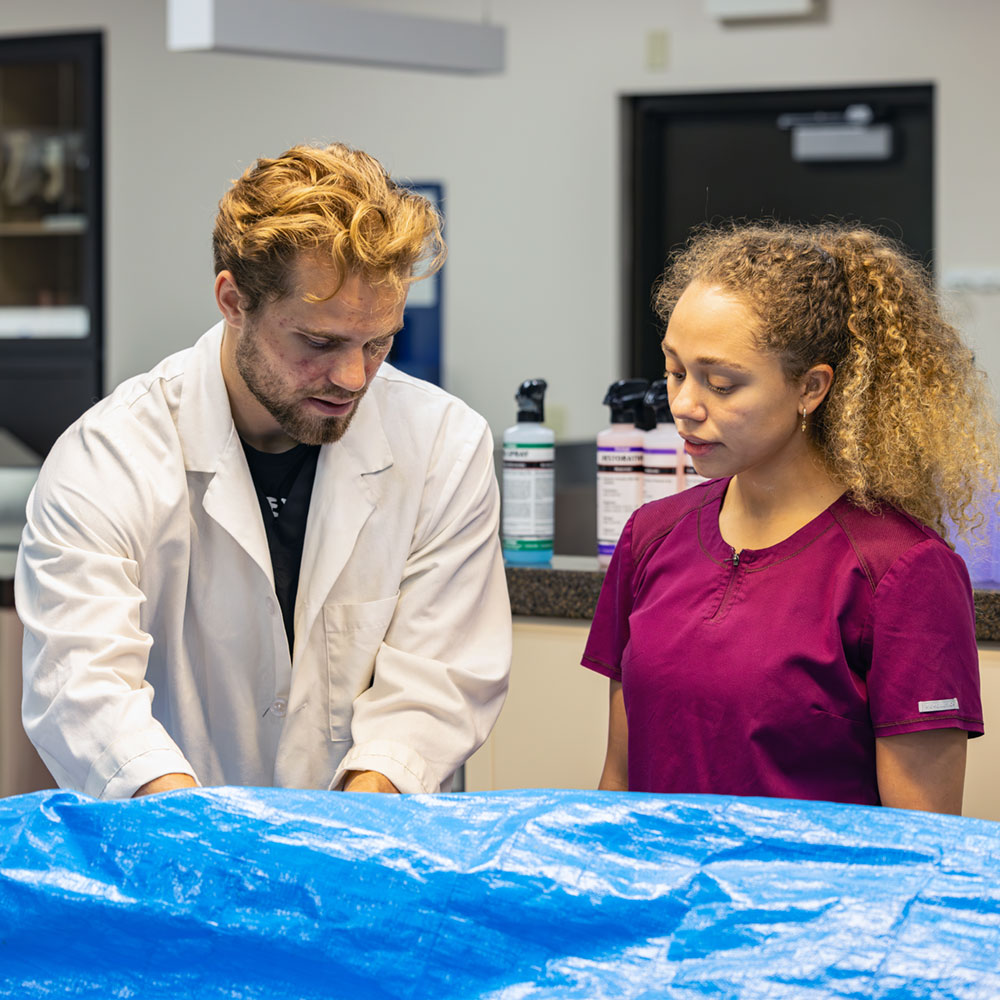
Enhanced understanding of anatomy
In the lab, as students dissect the body through skin, superficial fascia, muscle and bone. You will follow the point locations through each layer of tissue.
Come away with a deeper understanding of all the anatomical structures that the acupuncture needle is stimulating, and at which depths different tissues can be accessed by the needle. Seeing the structures firsthand also helps you avoid any risk of needling in the wrong place or at the wrong depth. You will be able to practice better point location skills after graduation.

Combining Eastern and Western Philosophies
National University of Health Sciences’ anatomy program is an ideal example of the productive integration of a Western and Eastern medical education.
The anatomy course was the first of its kind in the world when NUHS opened its master’s degree program in acupuncture in 2006. After seeing the benefits of integrating the functional eastern perspective on acupuncture points with a western structural perspective, other universities in Asia have created new anatomy programs similar to NUHS. This includes TianJin University in China.

Accepting western medicine does not hurt or contaminate our eastern medicine, but actually reinforces it and makes strong our weak points.
Dr. Yihyun Kwon, Professor, Clinical SciencesThe NUHS Advantage: Science & Anatomy
In this video, you’ll hear why former Acupuncture student Jacob Suh was excited about learning anatomy from dissecting real human cadavers in the university’s gross anatomy laboratory, and how understanding the physiology and science behind herbal medicine gives him a greater perspective on patient care.