As any great physician will attest, a thorough history is often the most essential and telling part of a patient encounter when making a diagnosis. However, no comprehensive exam would be complete without an associated physical examination as well. But what are we to do when we are not in an educational institution with hour-long new patient appointments, and instead must learn to manage our time more efficiently without compromising patient care? This is where I believe combination testing is crucial to any good doctor. Allow me to elaborate.
Orthopedic Exams
In addition to taking patient vitals and perhaps performing relevant neurologic tests, orthopedic tests can provide some of the most valuable insight into a patient’s presenting condition and can often rule in or out what our prior verbal history may have been directing us toward. Orthopedic exams are often taught in clusters, meaning a few tests performed together can provide an adequate scan of a particular region or pathology. Here at Missouri Orthopaedic Institute (MOI), Dr. Miller has shown me another, perhaps even more efficient, method of performing a physical examination known as combination testing.
In school, we are taught a host of orthopedic exams, usually based on a specific region of injury or presentation. For example, we learn lumbar orthopedic exams in our lumbar examination and management class in trimester three, whereas we receive our cervical orthopedic exams in our cervical examination and management class in trimester four. What makes this particularly interesting is that there are often multiple orthopedic tests with completely different names and purposes that involve the exact same motions. The only difference between these exams is often simply the “positive” test finding.
For example, the straight leg raise (SLR), often considered a foundational orthopedic exam for chiropractors. While raising the leg into hip flexion with the knee extended may be uncomfortable for the patient, it is imperative to understand that reproduction of radicular symptoms at 30 degrees of hip flexion may indicate a nerve root lesion, while discomfort in the back of the leg at 70 degrees of hip flexion is considered “negative” for the SLR, but still provides some details involving the patient’s hamstring tension. Another great example is the portion of the slump test that involves cervical flexion. By lowering the head to the chest, this motion mirrors a multitude of orthopedic tests, including Soto-Hall’s, Lhermitte’s, Lindner’s and Brudzinski’s tests. These tests range in application from meningitis all the way to multiple sclerosis. By performing this maneuver during the slump test, the absence of symptom aggravation also helps rule out positives for these other exams.
The Rationale
In Dr. Miller’s article* titled “The Slump Test: Clinical Applications and Interpretations,” he explains step-by-step how his version of the slump test directly mirrors several orthopedic tests, including: straight leg raising, Kernig’s, Braggard’s, Lindner’s, Lhermitte’s, Soto-Hall’s, Brudzinski’s, Fajersztain’s, the sitting straight leg raise test and Bechterew’s. By positioning the patient in this advanced manner, the absence of symptom elevation can rule out many positives in one swoop. However, should the position create pain beyond average discomfort, it becomes time for the investigative mind of the doctor to engage and break the test down into its rudimentary segments to determine which component is responsible for the pain.
This is what being a doctor is all about. Anyone can be instructed on how to position a patient. It is the understanding of how a single motion affects all of a patient’s tissues, whether joints, ligaments, muscles, nerves, vasculature, or even the meningeal tract, for which we go to school. It is absolutely imperative that we take a moment to visualize how anatomy moves in unison, and while we would prefer an orthopedic exam to be specific to one pathology, it is often not that simple.
As someone once wisely said: “Be the doctor, doctor.”
—
Read more about the MOI internship experience from NUHS alumnus Irving Leon, DC ’25.
*“The slump test: Clinical applications and interpretations,” was originally published in Chiropractic Technique, ©1999 by the National College of Chiropractic, Volume 11, No. 4, November 1999.
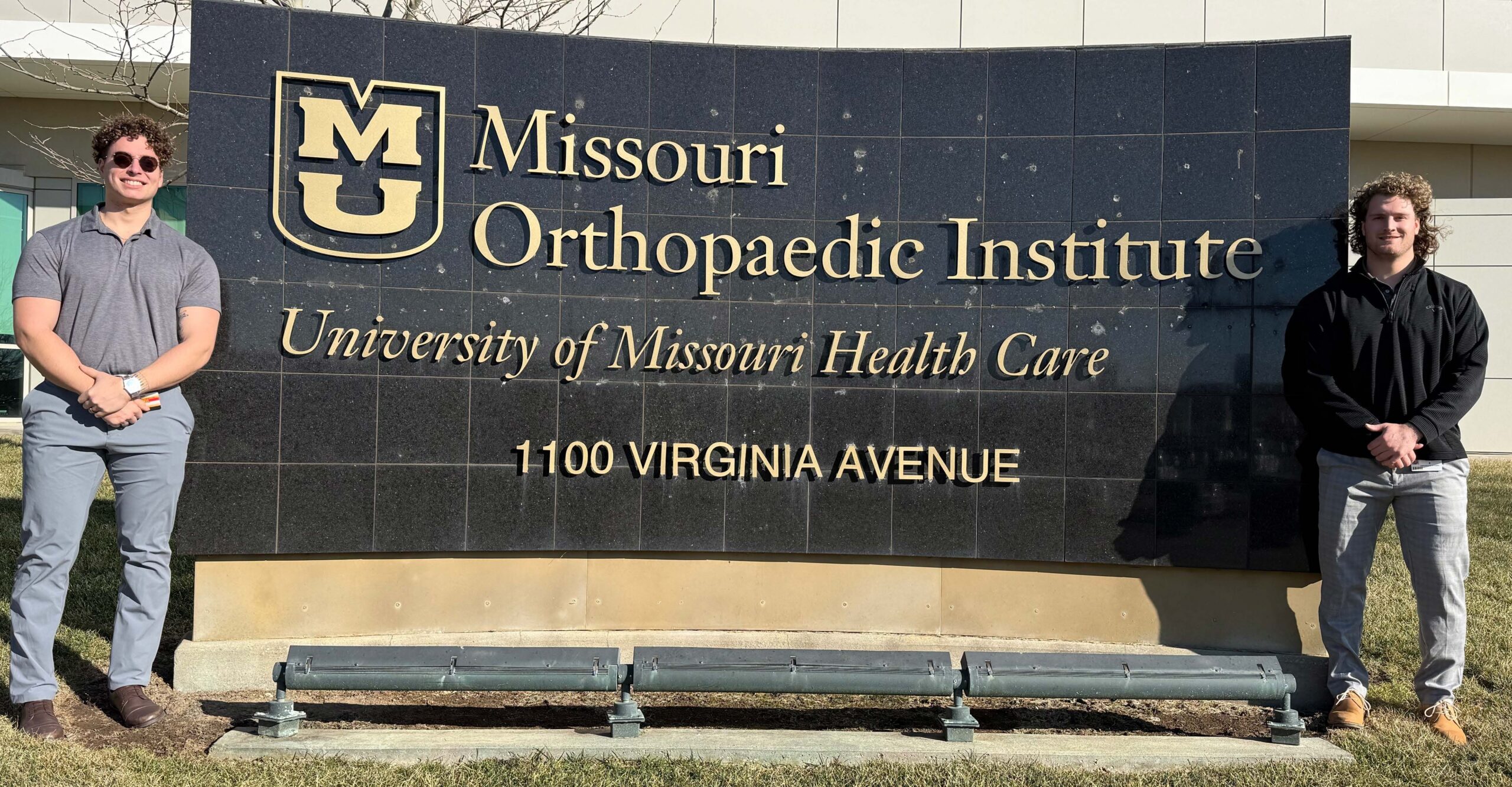
Photo caption: NUHS Florida DC student interns Dylan Kahn and Jacob Rivard outside of MOI.