The Book
As an acupuncture student at a university of integrative health, I find it important to explore acupuncture outside of the standard Traditional Chinese Medicine (TCM) curriculum. I recently checked out a book on acupuncture strategy at our on-campus James F. Winterstein Library. Acupuncture and Osteopathy to Treat Musculoskeletal Pain of the Extremities: The Mazzanti AcuOsteo Method, which is written by Italian osteopath and acupuncturist Umberto Mazzanti, and published in 2024.
After 40 years of experience treating musculoskeletal (MSK) pain, Dr. Mazzanti has written a book that demonstrates his acupuncture treatment strategy. The book explains the needling order he follows to achieve the best results possible for MSK patients. While a thorough explanation of the method would need more than a short blog post, my hope is to give those who are interested in MSK acupuncture a sense of what they stand to learn if they choose to read the book!
The Method
The Five Options is the name of the acupuncture approach Mazzanti recommends for the treatment of acute and chronic MSK pain in the limbs due to Qi stagnation, Blood stasis and Qi and Blood deficiency in the channels. Each option is followed by a number of corresponding sequential steps. The book suggests that Options One and Two and their steps must always be performed, and Options Three through Six are additional options that acupuncturists can utilize after evaluating the effectiveness of Option One and Option Two. The Five Options and their steps are outlined below:
Option One: Distal Points
– First Step: Jing-Well Points
– Second Step: Luo-Connecting Points (of the unaffected side)
– Third Step: Empirical Points (of the unaffected side)
– Fourth Step: Opposite Extremity Points (upper/lower)
– Fifth Step: Categories of Traditional Points (The 5 Shu Transporting)
– Sixth Step: Opening Points of the Extraordinary Vessels
Option 2: Local Points
– First Step: Painful Point(s) (Ah Shi)
– Second Step: Anatomically Mirrored Point(s)
Option 3: Adjacent Points
Option 4: Etiological Points
– First Step: Points According to Patterns
– Second Step: General Points
Option 5: Microsystems
– First Step: WAA (Wrist Ankle Acupuncture)
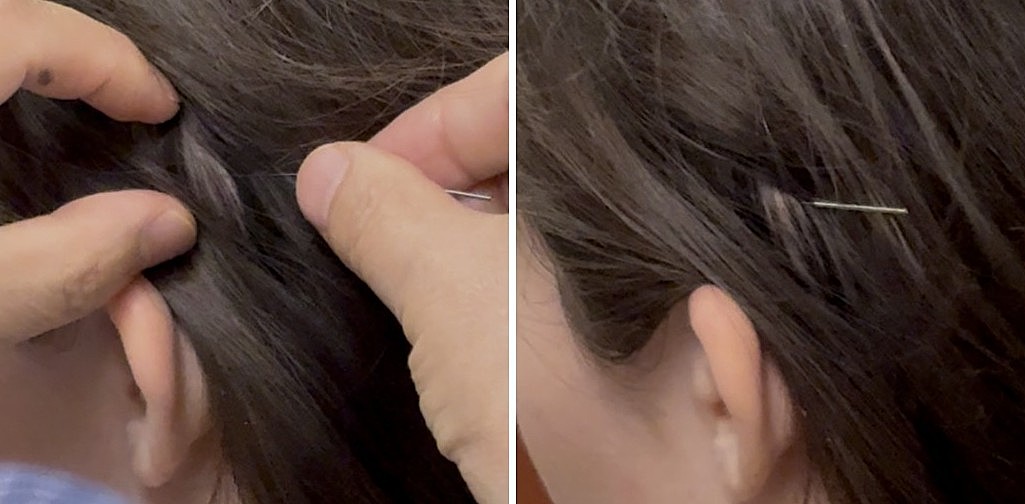
– Second Step: Auricular Acupuncture
An Example
To put this outline into practice, let’s walk through how the approach can be applied to a right lateral ankle sprain.
Option One: Distal Points
Step one, the Jing-Well points of the Gallbladder and Bladder channels (due to their location on the lateral side of the ankle) will be selected, GB44 and BL67. Step two, the left-side Luo connecting points of the Gallbladder Channel and Bladder Channel, GB37 and BL58, are selected. The Luo points of the internally/externally related Zang Fu organ pairs are LV5 and KD4; they can also be selected on the left side after GB37 and BL58 have been needled. Empirical points are points that are classically recommended based on TCM theory; there are no commonly used points according to classical theory for this type of injury/pain. Therefore, step three can be skipped, and step four can be fulfilled using SJ4 and SI5 on the left side wrist (opposite extremity).
The fifth step primarily involves utilizing the Shu-Stream points, GB41 and BL65, on the right (affected) side. After needling these, SJ3 and SI3 can also be used on the left (unaffected) side, as they are the corresponding Shaoyang and Tai Yang pairs according to the six-level theory. Jing-River points (GB38 and BL60) and Xi-Cleft points (GB36 and BL63) can also be used in treating external pathogenic factors and Blood stasis, respectively. As for the sixth step, there are no relevant extraordinary vessels in this instance of injury.
Note that for distal points one needle should be inserted at a time; for example, the needle in GB41 should be removed before BL65 is needled, and the needle in BL65 should be removed before SJ3 is needled.
Option Two: Local Points
The Ah Shi point must be felt based on palpation. Find the most painful point according to the patient and needle it. GB40, BL62, and BL60 are common locations for lateral ankle sprain pain. After needling one, two, or a few Ah Shi points, move to the left (unaffected) side and place a needle in the same place the right-sided Ah Shi was placed.
Option Three: Adjacent Points
Points adjacent to the injury will be selected to address surrounding MSK structures that could be impacting the injury. ST41, GB34, and BL61 are common adjacent points that are selected for a lateral ankle sprain
Option Four: Etiological Points
For the first step of points according to patterns, select LI4 and LV3 bilaterally to promote the free flow of Qi and Blood. ST36 bilaterally can be selected to tonify Qi and Blood. SP5 and SP9 are important points if the ankle is swollen given their ability to resolve dampness. For the second step of general points, select GB34 and BL18 bilaterally. GB34 is the Hui-Gathering point of the sinews. BL18 is the Back-Shu point of the Liver.
Option Five: Microsystems
While this option requires a more in depth- understanding of WAA and auricular acupuncture, I will list the points to be used for a lateral ankle sprain according to Mazzanti’s method. For WAA: Lower 5, Lower 6, Lower 4. For Auricular: Ankle Point, Liver Point, Subcortex Point, Shenmen point.
Check it Out!
For more information on how to treat injuries of the ankle, shoulder, elbow, wrist, hip and knee, with acupuncture, consider giving this 259-paged, nicely-written book a read!
Book ISBN: 978-0-323-83194-9