The Prerequisite Program at National University
Take one or several required bachelor’s level science courses in the NUHS Prerequisite Program.
You can choose the accelerated format, which consists of two 8-week sessions. You will complete your science requirements in just one trimester.
Or, you can take the non-accelerated format, which is one 15-week session.
Our Prerequisite Curriculum
Accelerated Program
The Accelerated Program is 15 weeks long and comprised of two 8-week sessions. Courses are generally scheduled Monday through Friday from 5:00 p.m. to 9:00 p.m. with an independent laboratory scheduled in Weeks 8-15 of the trimester at the student’s convenience.
| Course # | Credits | Description | Days / Times |
|---|---|---|---|
| BIOL201 | 3.0 | Human Physiology 1: Control Systems | Tu/Th, 5-8pm |
| BIOL203 | 3.0 | Human Physiology 2: Body Functions | Tu/Th, 5-8pm |
| CHEM116 | 1.0 | General Chemistry 1 Lab | W, 5-9pm |
| CHEM118 | 1.0 | General Chemistry 2 Lab | W, 5-9pm |
| CHEM206 | 1.0 | Organic Chemistry 1 Lab | M, 5-9pm |
| CHEM207 | 1.0 | Organic Chemistry 2 Lab | M, 5-9pm |
| CHEM111 | 3.0 | General Chemistry | Online |
| CHEM113 | 3.0 | General Chemistry 2 | Online |
All course days/times are subject to change.
BIOL201 Human Physiology 1: Control Systems – Credits 3.0 (7.5 weeks)
The physiology of the cell, signaling mechanisms, cellular transport mechanisms, and human biological control systems will be investigated. Topics to be studied are cell structure and function, movement of molecules across cell membranes, homeostatic mechanisms, and cellular communication. The metabolic pathways of glycolysis, Krebs cycle, and oxidative phosphorylation are incorporated into discussions of cell function. The nervous and sensory systems are studied along with their control mechanisms. The examination of the muscular system function is extended to include its control of body movements.
Prerequisite: None Offered: Fall, Spring, Summer
BIOL203 Human Physiology 2: Body Functions – Credits 3.0 (7.5 weeks)
The study of human organ systems includes mechanisms of control using negative feedback. Processes such as bulk, laminar, and turbulent flow as applied to different organ systems are taught. Other significant topics taught include the function and movement of molecules across cell membranes as applied to the respiratory, circulatory, digestive, renal, and reproductive systems, and the alteration and regulation of those activities by local, hormonal and neural inputs. Prerequisite: BIOL201 Offered: Fall, Spring, Summer
CHEM111 (Online) General Chemistry 1 – Credits 3.0 (7.5 weeks)
Foundations of chemistry, atoms, and molecules. Principles of stoichiometry, chemical reactions, properties of gases, periodicity and chemical bonding. Energy changes in chemical systems and electronic structure of atoms, and molecules. Examination of the chemical reactivity of common elements, inorganic and organic compounds.
Prerequisite: MATH135 Offered: Fall, Spring, Summer
CHEM113 (Online) General Chemistry 2 – Credits 3.0 (7.5 weeks)
Properties of liquids and solutions, and principles of acid-base equilibria, solubility, and electrochemical processes. Examination of chemical kinetics and equilibria.
Prerequisite: CHEM111 or equivalent Offered: Fall, Spring, Summer
CHEM116 General Chemistry 1 Lab – Credits 1.0 (7.5 weeks)
This is an in-class course implementing through experiment, the foundations of chemistry, atoms, and molecules, principles of stoichiometry, chemical reactions, properties of gasses, periodicity and chemical bonding, energy changes in chemical systems and electronic structure of atoms and molecules, examinations the chemical reactivity of common elements, and inorganic and organic compounds. Students will also learn safety in the lab.
Pre-Requisite: MATH135 Co-Requisite: CHEM111 Offered: Fall, Spring, Summer
CHEM118 General Chemistry 2 Lab Credits – 1.0 (7.5 weeks)
This is an in-class lab course implementing topics in general chemistry and analytical chemistry covering phase transitions, thermochemistry, spontaneity/equilibrium, electrochemistry, kinetics, bonding, order/symmetry in condensed phases, coordination compounds, and descriptive chemistry.
Prerequisites: CHEM111 and CHEM116 Corequisites: CHEM113 Offered: Fall, Spring, Summer
CHEM206 Organic Chemistry 1 Lab – Credit 1.0 (7.5 weeks)
CHEM206 Lab accompanies Chem201S Organic Chemistry lecture. This laboratory course is an introduction to the techniques commonly used in the organic chemistry laboratory, an introduction to the synthesis of organic molecules, and an introduction to basic laboratory techniques; such as distillation, melting point, extraction of known and unknown mixtures, recrystallization, synthesis of compounds, and experiments utilizing basic organic techniques.
Prerequisite: CHEM113 Corequisite: CHEM201 Offered: Fall, Spring, Summer CHEM207 Organic Chemistry 2 Lab (7.5 weeks) Credit 1.0
CHEM207 Organic Chemistry 2 Lab – 1.0 (7.5 weeks) Accompanies CHEM203 Organic Chemistry lecture.
This laboratory course is an introduction to the techniques commonly used in the organic chemistry laboratory, an introduction to the synthesis of organic molecules, and an introduction to basic laboratory techniques; such as distillation, melting point, extraction of known and unknown mixtures, recrystallization, synthesis of compounds, and experiments utilizing basic organic techniques.
Prerequisite: CHEM201 and CHEM206 Corequisite: CHEM203 Offered: Fall, Spring, Summer
Non-Accelerated Program
The Non-Accelerated Program is 15-weeks long. Courses are generally scheduled Monday through Friday from 5:00 p.m. to 10:00 p.m.
| Course # | Credits | Description | Days / Times |
|---|---|---|---|
| BIOL205 (Online) | 1.0 | Human Physiology Lab | Online |
| BIOL221 | 4.0 | Anatomy 1 | Tu, 5-10pm |
| BIOL223 | 4.0 | Anatomy 2 | M, 5-10pm |
| BIOL231 (Online) | 3.0 | General Microbiology | Online |
| BIOL401 (Online) | 1.0 | Current Topics in the Biosciences 1 | Online |
| BIOL402 (Online) | 1.0 | Current Topics in the Biosciences 2 | Online |
| CHEM201 (Online) | 3.0 | Organic Chemistry 1 | Online |
| CHEM203 (Online) | 3.0 | Organic Chemistry 2 | Online |
| CHEM 301 | 4.0 | Biochemistry | W/F, 5-7pm |
| PHYS111 | 3.0 | Physics 1 | Th, 5-8pm |
| PHYS113 | 3.0 | Physics 2 | Tu, 5-8pm |
| PHYS115 (Online) | 1.0 | General Physics Lab | Online |
| PHYS117 | 1.0 | Physics 2 Lab | Tu, 8-10pm |
| PHYS211 | 3.0 | Kinesiology | Tu, 6-9pm |
All course days/times are subject to change.
BIOL205 (Online) Human Physiology Lab – Credit 1.0
Students will perform 10 laboratory exercises illustrating fundamental principles in physiology. The labs will involve exercises covering the following topics: cell transport and membrane permeability; skeletal muscle and neurophysiology; mechanisms involving the endocrine, cardiovascular and respiratory systems; as well as function and regulation in renal system physiology and acid-base balance.
Co-requisite: BIOL201 Offered: Fall, Spring, Summer
BIOL221 Anatomy 1 (plus Lab) – Credits 4.0
In this course, students will learn, in both lecture and laboratory formats, the basic concepts of human anatomy with an emphasis on the relationship between structure and function. Basic concepts such as anatomical terminology, position, and relationship will be discussed in order to provide a foundation onto which other anatomical concepts will be taught. In addition, the normal gross anatomy of the musculoskeletal system (including the osteology, arthrology, and myology of the different anatomical regions) and the spinal cord will be presented. The gross anatomy laboratory sessions will be presented using a regional approach in order to facilitate greater integration of the lecture material.
Prerequisite: None Offered: Fall, Spring, Summer
BIOL223 Anatomy 2 (plus Lab) – Credits 4.0
In this course, students will learn in lecture and laboratory formats, the normal gross structures of the human brain (including special senses and the autonomic nervous system) and organ systems. The organ systems discussed are the cardiovascular, respiratory, lymphatic, endocrine, urinary, digestive, and reproductive. In addition, the structural interrelationships between organ systems will be explained as well as the interrelationships between structure and function of organs and organ systems. The gross anatomy laboratory sessions will be presented using a regional approach and will be designed to support the lecture sessions and address related basic science issues.
Prerequisite: BIOL221 Offered: Fall, Spring, Summer
BIOL231 (Online) General Microbiology – Credits 3.0
This course will introduce students to the microbial world. General properties of microorganisms including classification, morphologic and growth characteristics, metabolism, and genetics will be discussed. The methods to study microorganisms will be discussed in detail. Students will explore the applications of microbiology to modern diagnostics and biotechnology. The course will consist of didactic and group discussion format. Prerequisite: None Offered: Fall, Spring, Summer
BIOL401 (Online) Current Topics in the Biosciences 1 – Credits 1.0 (7.5 weeks)
This course highlights current topics in the biosciences, particularly through recent novel publications or controversial topics. The course will focus on searching, reading and assessing scientific literature. Scientific areas that may be covered include molecular biology, genomics, immunology, infectious disease, and medical technology. This course is intended for in-depth study of one or a few relevant topics. The student will choose a topic, either from examples provided or from their own interest, and spend the duration of the course researching this topic. If BIOL401 and BIOL402 are taken, topics must not be repeated and may only be taken in a student’s last trimester. Prerequisite: Any Biology course Offered: Fall, Spring, Summer
BIOL402 (Online) Current Topics in the Biosciences 2 – Credits 1.0 (7.5 weeks)
This course highlights current topics in the biosciences, particularly through recent novel publications or controversial topics. The course will focus on searching, reading and assessing scientific literature. Scientific areas that may be covered include molecular biology, genomics, immunology, infectious disease, and medical technology. This course is intended for in-depth study of one or a few relevant topics. The student will choose a topic, either from examples provided or from their own interest, and spend the duration of the course researching this topic. If BIOL401 and BIOL402 are taken, topics must not be repeated and may only be taken in a student’s last trimester.
Prerequisite: Any Biology course Offered: Fall, Spring, Summer
CHEM201 (Online) Organic Chemistry 1 – Credits 3.0
Structure and bonding in organic chemistry, Isomerism, and stereoisomerism in organic compounds. Chemistry of alkanes, cycloalkanes, alkenes, and alkynes. Aromatic compounds and mechanisms of aromatic substitution. Nucleophilic addition and substitution reactions. Chemistry of alcohols, ethers, aldehydes, and ketones.
Prerequisite: CHEM113 or equivalent Offered: Fall, Spring, Summer
CHEM203 (Online) Organic Chemistry – 2 Credits 3.0
This course will explore the chemistry of carboxylic acids and their derivatives, as well as amines and related nitrogen compounds; applications of spectroscopic techniques in organic chemistry; introduction to biochemistry, which will examine amino acids, carbohydrates, lipids, and nucleic acids; structure and properties of proteins and enzymes.
Prerequisite: CHEM 201 or equivalent Offered: Summer Only
CHEM301 Biochemistry – Credits 4.0
This course focuses on the chemistry of amino acids, carbohydrates, lipids, and nucleic acids, with special emphasis on representative proteins and enzymes, including hemoglobin, myoglobin, and cytochromes P450. Prerequisite: BIOL203 or any biology course Offered: Fall, Spring, Summer
PHYS111 Physics 1 Credits 3.0 Non-calculus-based study of classical linear and rotational kinematics and dynamics (including work, energy, impulse, momentum, and collisions), fluids, periodic motion, sound and wave motion.
Prerequisite: College Algebra (MATH135) or equivalent Offered: Fall, Spring, Summer
PHYS113 Physics – 2 Credits 3.0
Non-calculus-based study of electrostatics, electric fields, Gauss’ law, capacitance, current, resistance, magnetic forces and fields, electromagnetic induction, DC and AC circuits, electromagnetic waves, optics, and modern physics, as well as an introduction to quantum physics.
Prerequisite: Physics111 Offered: Summer 197
PHYS115 (Online) General Physics Laboratory Credit – 1.0
Non-calculus-based virtual lab study of classical linear mechanics and dynamics (including work, energy, impulse, momentum ad collisions), periodic motion, sound and wave motion, electricity and circuits. Prerequisite / Co-requisite: MATH135, PHYS111 Offered: Fall, Spring, Summer
PHYS117 Physics 2 Laboratory – Credit 1.0
This is a course that will allow students to learn/experience a “hands-on” approach to physics. The lab will comprise those experiments that are important to the understanding of the Laws and Concepts of College Physics as it prepares the students for a course in science that furthers their education or prepares them for a career in the arena of science-based health care.
Prerequisite or Corequisite: PHYS111 Offered: Summer only
PHYS211 Kinesiology Credits – 3.0
Understanding human activity from a mechanical and physiological perspective so to address major issues, which include reducing the risk of injury, optimizing exercise prescription, and understanding clinical evaluations. Functional anatomy, muscle and passive tissue mechanics, anthropometry, electromyography, and linked segment mechanics are introduced and applied to clinical, occupational and athletic situations. Basic concepts of cardiovascular, respiratory, and thermoregulatory responses to physical activity.
Prerequisite: None Offered: Fall
Begin Your Journey
Campus Location and Facilities
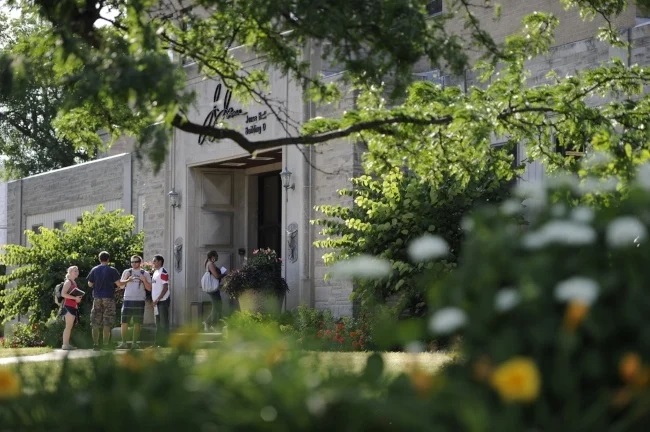
National University of Health Sciences is conveniently located 15 miles from the city of Chicago with easy access by car or Metra train. Students come from across the country and internationally, creating a diverse student body.