 Oriental medicine seeks to achieve healing through rebalancing a patient’s “qi” or life energy. All treatment in oriental medicine revolves around a very comprehensive history and evaluation to achieve an accurate diagnosis. The diagnosis informs the practitioner what steps he or she should take to rebalance the patient’s system and allow the patient’s natural healing mechanisms to function properly to restore health and harmony.
A practitioner of oriental medicine has many healing arts and tools at his/her disposal. While the major avenues of patient treatment are the use of acupuncture and traditional herbal medicine, there are other lesser-known therapies that oriental medicine employs in conjunction with these to augment and accelerate the healing process.
Here are some important yet lesser-known therapies in oriental medicine that can play a role in patient healing:
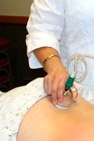
Cupping: Cupping is a therapy whereby a hollow fist-sized cup is heated inside to create a vacuum. (Modern style cups are made from plastic materials and practitioners often use suction instead of heat to create a vacuum.) The cup is then placed on the patient’s skin with the open side down, where it adheres to the patient’s body due to the suction of the vacuum inside the cup. This gentle suction, applied in the correct manner, can encourage healing and pain relief. The practitioner may place several cups on a patient in specific patterns, or slide the cup from one point to another – a technique known as “gliding.” Typically, cupping is used to open a meridian, which is a channel of energy flow. Practitioners use this method to release toxins, improve lymphatic drainage, remove blood stasis, and more. It can also be used as a technique for deep tissue massage.
Moxibustion: Moxibustion is a traditional oriental medicine technique that originated in the northern part of China. Moxibustion is named after “moxa,” a dried herbal powder preparation made from the herb mugwort.
There are three different moxibustion techniques: direct, indirect and needle. Direct moxibustion places a small cone of ignited moxa directly on top of a specific acupuncture point on the skin, removing the cone before it burns the skin. Indirect moxa uses a burning moxa cone placed on a stick or other media in order to heat the acupuncture point. This is more popular because it is safer and easier to control the temperature. Needle moxibustion places the burning moxa above acupuncture needles inserted into the acupuncture point.
In all three versions of the technique, the burning of the herb warms and draws energy and blood circulation to the specific points for a stimulating affect on the patient’s qi. Moxibustion therapy is used for many different conditions such as digestive disorders, musculoskeletal pain, headaches, rheumatoid arthritis, osteoarthritis, menstrual disorders, etc.
Gua Sha: In Gua Sha, the practitioner applies repetitive scraping motions with a special blunt edged instrument in therapeutic places on the patient’s body. This encourages the release of toxins and can draw healing energy within the body to specific sites or organ systems. Gua Sha can leave temporary petechiae for a few hours or days after treatment, but the process itself is usually painless. Depending upon the severity of the patient’s blood stasis, the skin color changes that occur after Gua Sha will vary. Gua Sha is commonly used to reduce fever, treat cough, address musculoskeletal conditions, and reduce pain.
Tuina: Tuina is a therapeutic form of bodywork that applies various techniques such as brushing, kneading, rolling, pressure, rubbing, etc., to key acupuncture points or along energy meridians of the patient’s body. In Tuina, the goal is to encourage energy flow and dissolve blockages or barriers to the smooth movement of qi. It has been used to treat many conditions such as musculoskeletal disorders, chronic stress related disorders, gastrointestinal conditions, respiratory disorders, and also reproductive disorders.
Chinese Dietary Therapy: Foods have energetic properties in oriental medicine. Specific foods and flavors can be been organized into categories based on the heating or cooling affect they have on the body, the direction in which they move qi, and how they affect qi, blood flow and specific organ systems. When a patient is diagnosed with an imbalance or energy blockage in her liver, for example, she may be advised to include more foods that stimulate the liver and avoid foods that impede energy flow to the liver.
In oriental medicine, one or more of the above healing tools can be combined for an amplified and synergistic healing effect. Having other healing modalities at hand is also helpful when acupuncture is contraindicated or a patient has a fear of needles. Prescriptive dietary changes can also provide a patient with means to continue his or her health treatment at home, supporting the efforts of his oriental medicine provider between office visits.
Oriental medical schools with a comprehensive and traditional curriculum like NUHS, not only offer comprehensive training in acupuncture and herbal medicine, but also provide students with training in the many other modalities of their profession, like those listed above. This well-rounded training prepares authentic oriental medicine practitioners who have more to offer their patients.